

Agentic AI vs General-Purpose AI for Marketing: Why Marketing-Specific Models Deliver Real ROI
- Jane

- Dec 11, 2025
- 20 min read
The marketing world is drowning in AI tools that promise everything and deliver excuses. While CMOs invest millions in ChatGPT, Claude, and Gemini for their marketing teams, 93% are still struggling to see measurable ROI from their AI investments. The problem isn’t AI itself—it’s the fundamental mismatch between general-purpose models and marketing’s unique demands.
Marketing behaves like a strategy game: real-time, non-linear, opponent-influenced, and multi-path. Your competitors adapt their messaging while you’re crafting the perfect ChatGPT prompt. Customer preferences shift while you’re waiting for Claude to generate suggestions you’ll need to implement manually. Market conditions change while you’re fact-checking Gemini’s latest hallucination about your industry metrics.
Yet most teams are using AI tools designed for essay writing and general conversation, then wondering why they can’t prove ROI to the C-suite. It’s like bringing a calculator to a Formula 1 race—technically impressive, but fundamentally wrong for the challenge at hand.
This comprehensive analysis reveals why agentic AI powered by marketing-specific models doesn’t just outperform general-purpose solutions—it delivers the 6× ROI that traditional agencies promise but never provide. While everyone else adapts generic tools for marketing tasks, the future belongs to AI built specifically for marketing reality.
The stakes couldn’t be higher. Companies that choose purpose-built marketing AI are achieving 300% average ROI in 2025, while their competitors struggle to justify expensive subscriptions to general-purpose tools. The window for competitive advantage is closing rapidly as AI marketing automation delivers 544% ROI for companies smart enough to choose specialized solutions over adapted alternatives.

Why General-Purpose AI Falls Short in Real Marketing Scenarios
The harsh reality hitting marketing teams worldwide is that ChatGPT, Claude, and Gemini weren’t built for marketing—and it shows in every frustrated interaction, every manually implemented suggestion, and every campaign that fails to deliver promised results.
Consider the daily nightmare of using ChatGPT for competitive analysis. You ask for insights about a competitor’s recent campaign launch, and ChatGPT confidently provides analysis based on training data from months or years ago. By the time you fact-check the information, research current competitive positioning, and develop your response strategy, your competitor has already captured market share. ChatGPT requires constant fact-checking for marketing claims and struggles with real-time competitive data, leading to campaigns based on outdated or inaccurate information.
The situation with Claude presents different but equally frustrating challenges.
Marketing professionals report that Claude’s overly cautious nature refuses creative marketing requests that push boundaries—the very creativity that drives breakthrough campaigns. Ask Claude to develop edgy social media content or contrarian positioning strategies, and you’ll receive sanitized suggestions that sound like they came from a compliance manual. Claude’s risk-averse programming and lack of live browsing capabilities make it unsuitable for time-sensitive campaign optimization where competitive advantage depends on rapid response to market opportunities.
Gemini compounds these problems with inferior writing quality and higher hallucination rates in complex marketing scenarios. Marketing teams using Gemini for content creation report spending more time editing and fact-checking than they would writing original content themselves. When complex marketing tasks require human oversight anyway, what’s the point of the AI assistance?
But the most damaging limitation across all three platforms is their fundamental inability to execute independently. These tools generate suggestions—nothing more. They can’t implement campaigns, optimize performance based on real-time data, or make autonomous adjustments when market conditions change. All three models lack autonomous execution capabilities—they generate suggestions but cannot implement, measure, or optimize campaigns independently.
This creates the “suggestion trap” that marketing teams fall into: endless cycles of prompting, receiving suggestions, manually implementing recommendations, measuring results, then starting the cycle again. Meanwhile, nimble competitors using autonomous marketing systems are executing, optimizing, and scaling campaigns while you’re still crafting prompts.
The deeper problem lies in marketing-specific context understanding that is severely limited across general-purpose models. These systems don’t grasp attribution models, customer lifetime value calculations, or marketing mix optimization. They can’t distinguish between vanity metrics and revenue-driving KPIs. They don’t understand the complex interplay between brand awareness campaigns and direct-response initiatives.

Consider a real-world example: You need to optimize a multi-channel campaign that includes paid search, social media advertising, email marketing, and content syndication. Each channel requires different messaging, timing, and optimization strategies based on customer journey stage and attribution touchpoints.
With ChatGPT, you’d need separate conversations for each channel, manual implementation of all suggestions, constant monitoring for performance changes, and human analysis to understand cross-channel attribution effects. The process takes weeks and requires extensive marketing expertise to interpret and execute the AI’s suggestions correctly.
An autonomous marketing system handles this scenario differently: it analyzes performance across all channels simultaneously, identifies optimization opportunities based on real attribution data, implements changes automatically, and continues optimizing based on real-time results. The difference between a co-worker and a tool becomes crystal clear when you need actual marketing execution, not just suggestions.
Integration limitations compound these challenges by keeping general-purpose AI tools in silos, unable to connect with marketing tech stacks for seamless workflow execution. Your CRM data stays in Salesforce, your campaign performance remains in Google Analytics, and your customer support insights live in Zendesk—while your AI tool operates in complete isolation from the data it needs to provide relevant recommendations.
As research on domain-specific models conclusively demonstrates, purpose-built AI solutions achieve significantly higher accuracy than general-purpose models adapted for specialized tasks. The adaptation approach—taking a general tool and hoping it works for marketing—represents a fundamental misunderstanding of how AI systems achieve optimal performance.
Marketing leaders who understand what an AI marketing agent actually entails are moving beyond the limitations of adapted general-purpose tools toward solutions built specifically for marketing’s unique demands.
“We wasted eight months trying to make ChatGPT work for our demand generation campaigns. The constant prompt engineering, fact-checking, and manual implementation consumed more resources than traditional marketing methods. When we switched to purpose-built marketing AI, we saw 340% ROI improvement within the first quarter.” — CMO, Fortune 500 SaaS Company
The evidence from a comprehensive ChatGPT vs Claude vs Gemini marketing comparison reveals consistent patterns: general-purpose models excel at general tasks but struggle with marketing’s complex, interconnected challenges that require domain expertise, real-time data integration, and autonomous execution capabilities.
This fundamental inadequacy explains why forward-thinking companies are turning to agentic AI designed specifically for marketing’s unique demands, where autonomy and specialization combine to deliver the ROI accountability that general-purpose tools can never provide.
Understanding Agentic AI: Autonomy vs Assistance
The marketing world stands at a critical inflection point between AI that assists and AI that executes. Most marketing teams are stuck in the assistance paradigm—using AI tools that generate suggestions, create drafts, and provide recommendations that still require human implementation, optimization, and management. Agentic AI represents a fundamental shift from assistance to autonomy, from tools to co-workers, from suggestions to execution.
Understanding this distinction requires grasping what true autonomy means in marketing contexts. Agentic AI operates independently to plan, execute, and optimize entire marketing workflows without constant human intervention. Instead of generating a social media content calendar that you must manually post, schedule, and monitor, agentic AI creates the strategy, publishes content across channels, analyzes engagement patterns, optimizes messaging based on performance data, and scales successful approaches automatically.
The difference becomes stark when you consider complex marketing scenarios that traditional AI tools handle poorly. Imagine launching a multi-channel acquisition campaign targeting enterprise customers across LinkedIn, Google Ads, industry publications, and email nurture sequences.
With traditional AI assistance, you’d prompt ChatGPT for LinkedIn ad copy, ask Claude for email sequences, use Gemini for landing page content, manually implement everything across platforms, monitor performance dashboards separately, and make optimization decisions based on human analysis of fragmented data. The process takes weeks and requires extensive marketing expertise at every step.
Agentic AI approaches this scenario as an integrated challenge requiring autonomous coordination. A marketing-focused agentic system analyzes your target audience data, competitive landscape, and available channels to develop an integrated strategy. It creates channel-specific content optimized for each platform’s audience and format requirements. It launches campaigns simultaneously across all channels while implementing cross-channel attribution tracking. Most importantly, it continuously optimizes messaging, budgets, and targeting based on real-time performance data without requiring human prompts or intervention.
This represents real-time adaptation capabilities that allow agentic AI to respond to market changes, competitor actions, and performance data without waiting for human input or new prompts. When a competitor launches a counter-campaign, agentic AI adjusts messaging and bidding strategies automatically. When certain audience segments show higher conversion rates, it reallocates budgets and scales successful approaches immediately.
The technical architecture enabling this autonomy involves multi-agent collaboration that enables specialized AI agents to work together on complex marketing challenges, similar to how expert teams function. One agent focuses on content creation and optimization, another handles media buying and budget allocation, while a third manages customer data analysis and segmentation. These agents communicate, coordinate, and execute unified strategies without human coordination overhead.
Consider how this multi-agent approach handles attribution analysis—one of marketing’s most complex challenges. Traditional AI tools provide attribution suggestions based on limited data visibility. Marketing teams must manually gather data from multiple platforms, create attribution models, and implement tracking across touchpoints.
Agentic marketing systems handle attribution through coordinated agent activity: one agent continuously collects first-party data from all customer touchpoints, another analyzes attribution patterns using advanced statistical models, while a third implements budget optimizations based on true incremental contribution analysis. The entire process operates continuously and autonomously, providing marketing teams with actionable attribution insights rather than theoretical recommendations.
Marketeam.ai’s Integrated Marketing Environment (IME) represents the world’s first agentic marketing platform, where specialized AI agents autonomously handle complete marketing functions from strategy development through performance optimization. This isn’t an adaptation of general-purpose AI—it’s purpose-built agentic architecture designed specifically for marketing’s unique requirements.
The platform demonstrates how the shift from prompt engineering to outcome specification transforms marketing efficiency. Instead of crafting perfect prompts for content creation, campaign setup, and performance analysis, marketing teams define business outcomes—increase qualified leads by 40%, reduce customer acquisition cost by 25%, improve marketing-qualified-to-sales-qualified lead conversion by 60%—and let agentic AI determine optimal execution paths.
This outcome-focused approach eliminates the “prompt fatigue” that marketing teams experience with traditional AI tools. No more spending hours crafting detailed prompts, waiting for responses, evaluating suggestions, and manually implementing recommendations. Agentic AI transforms the marketer’s role from AI prompt engineer to strategic outcome manager.
The autonomy extends to continuous learning and optimization that happens without human supervision. Traditional AI tools provide static responses based on training data, requiring humans to identify when approaches need adjustment. Agentic marketing AI continuously analyzes campaign performance, competitive actions, market trends, and customer behavior to identify optimization opportunities and implement improvements automatically.
“The difference between AI assistance and AI autonomy became clear when our agentic system identified and capitalized on a competitor’s pricing vulnerability while our team was asleep. By morning, we had gained 200 new enterprise prospects and repositioned our entire competitive messaging—without any human intervention.” — VP Marketing, Enterprise Software Company
This autonomous optimization capability proves particularly valuable in global marketing contexts where campaigns run across time zones and market conditions change constantly. While marketing teams sleep, agentic AI systems continue optimizing campaigns, responding to performance changes, and capitalizing on opportunities that traditional AI tools would miss entirely.
As industry analysis on agentic AI success demonstrates, the autonomous execution capabilities of agentic systems deliver measurable business results that far exceed the efficiency gains from AI assistance tools.
The fundamental insight driving Marketeam.ai’s philosophy of AI Agents as Co-Workers, Not Co-Pilots recognizes that marketing success requires execution, not just suggestions. True marketing AI doesn’t help you do marketing better—it does marketing autonomously while you focus on strategic direction and business outcomes.
But autonomy alone isn’t enough—the real competitive advantage comes from AI specifically designed to understand marketing’s unique language, metrics, and challenges, which requires purpose-built models that general-purpose AI can never replicate.
The Marketing-Specific Model Advantage
The technical superiority of domain-specific AI models over general-purpose adaptations isn’t just theoretical—it’s measurable, significant, and directly impacts marketing ROI. While most companies struggle to adapt ChatGPT or Claude for marketing tasks, marketing-specific language models understand industry terminology, attribution models, customer journey mapping, and conversion optimization in ways general models cannot replicate, no matter how sophisticated the prompting strategies become.
Consider the fundamental difference in how these systems process marketing concepts. When you mention “attribution modeling” to ChatGPT, it provides general definitions and basic examples drawn from its broad training data. A marketing-specific model understands the nuances between first-touch, last-touch, linear, time-decay, and position-based attribution models, knows when each approach provides optimal insights for different business models, and can implement sophisticated attribution analysis based on actual customer journey data.
This depth of understanding emerges from training on marketing-specific datasets that enable deeper contextual understanding of campaign performance metrics, customer lifetime value calculations, and marketing mix optimization. Instead of learning about marketing from general internet content, specialized models train on real campaign data, performance analytics, competitive intelligence reports, and marketing automation workflows.
Marketeam.ai’s proprietary models are trained on thousands of real-time marketing data points, competitive intelligence, and industry-specific knowledge that general-purpose models cannot access or replicate. This training includes anonymized campaign performance data across industries, real-time competitive positioning analysis, and comprehensive marketing automation workflows that reveal how successful marketing strategies translate into measurable business outcomes.
The practical impact of this specialized training becomes evident in complex marketing scenarios. When analyzing customer acquisition funnels, general-purpose AI might suggest optimizing conversion rates without understanding how funnel changes affect customer quality, lifetime value, or retention rates. Marketing-specific models inherently understand these interconnections and recommend optimization strategies that improve overall customer value, not just immediate conversion metrics.

Efficiency advantages represent another compelling reason for choosing specialized models: domain-specific models require 80% less computational power while achieving 40% higher accuracy in marketing-specific tasks. This efficiency stems from focused training that eliminates irrelevant information while deepening expertise in marketing-relevant domains.
General-purpose models waste computational resources processing vast amounts of non-marketing information to generate marketing insights. They must filter through literature, science, entertainment, and countless other domains to provide marketing recommendations. Marketing-specific models focus computational power exclusively on marketing-relevant processing, resulting in faster, more accurate, and more actionable insights.
The accuracy improvements are particularly significant in areas where marketing precision drives revenue impact. Customer segmentation analysis using marketing-specific models achieves 73% higher accuracy than general-purpose alternatives, directly translating into better targeting, reduced acquisition costs, and improved campaign performance.
Built-in understanding of marketing constraints represents a strategic advantage that general-purpose models struggle to replicate. Budget limits, compliance requirements, brand guidelines, and industry regulations are native to marketing-specific models rather than external rules requiring constant reinforcement through prompting.
When developing campaigns for regulated industries like healthcare or financial services, general-purpose AI requires extensive prompting about compliance requirements and often generates content that violates industry regulations. Marketing-specific models understand these constraints inherently and generate compliant strategies automatically, eliminating compliance risks while maintaining creative effectiveness.
Consider how different model types handle marketing mix optimization—a complex challenge requiring understanding of channel interactions, budget allocation strategies, and performance measurement across multiple touchpoints:
General-Purpose AI Approach:
Requires detailed prompting about each marketing channel
Provides generic optimization suggestions based on broad patterns
Cannot account for industry-specific channel effectiveness
Misses subtle interactions between channels that affect overall performance
Suggests optimization strategies without understanding business model implications
Marketing-Specific AI Approach:
Inherently understands channel characteristics and optimization opportunities
Analyzes channel interactions based on extensive marketing performance data
Accounts for industry-specific effectiveness patterns and seasonal trends
Optimizes for business outcomes rather than channel-level metrics
Implements optimization strategies that improve overall marketing ROI
The strategic competitive advantage through specialized knowledge cannot be easily replicated by general-purpose competitors. While companies can adapt ChatGPT or Claude for marketing tasks through prompting strategies, they cannot access the deep, marketing-specific training data and domain expertise that powers purpose-built marketing AI systems.
This creates a sustainable competitive moat: companies using marketing-specific AI gain advantages that competitors using adapted general-purpose tools cannot overcome through better prompting or additional training. The specialization represents fundamental architectural differences, not surface-level customizations.
As research on domain-specific LLMs conclusively demonstrates, specialized models consistently outperform general-purpose alternatives in domain-specific tasks, with performance gaps widening as task complexity increases.
The implications for marketing are profound. Complex marketing challenges—attribution analysis, customer lifetime value optimization, competitive positioning, and marketing mix modeling—represent exactly the type of domain-specific complexity where specialized models deliver overwhelming advantages.
Marketeam.ai’s breakthrough as the world’s first AI tailored specifically for marketing demonstrates how purpose-built models translate technical advantages into measurable business results.
“We tested ChatGPT, Claude, and Gemini for customer segmentation analysis over three months. Results were inconsistent and required extensive manual verification. Marketeam.ai’s marketing-specific models delivered 89% segmentation accuracy out of the box, with insights we never discovered using general-purpose tools.” — Director of Marketing Analytics, Fortune 500 Retail Company
Forbes analysis of domain-specific LLMs for enterprises reinforces that specialized AI models represent the next evolution beyond general-purpose adaptations, particularly for complex business functions like marketing that require deep domain expertise and autonomous execution capabilities.
The evidence is overwhelming: marketing-specific models don’t just perform better than adapted general-purpose alternatives—they operate in a different performance category entirely. These technical advantages translate directly into the measurable ROI that separates true marketing AI from expensive experiments with uncertain outcomes.
Real ROI: Measuring What Actually Matters
The marketing world has grown tired of AI vendors promising “efficiency gains” and “productivity improvements” while delivering unclear ROI and unmeasurable business impact. Companies implementing marketing-specific AI report 300% average ROI in 2025, compared to the unclear, often negative results from general-purpose AI adaptations that consume resources without delivering measurable business outcomes.
This dramatic ROI difference stems from fundamental distinctions in how specialized marketing AI approaches business outcomes versus how general-purpose tools generate suggestions requiring extensive human implementation and optimization.
When AI automatically improves campaign performance, reduces acquisition costs, and increases customer lifetime value, ROI becomes measurable and significant. When AI generates suggestions that require human analysis and manual implementation, ROI remains theoretical and often negative after accounting for implementation costs.
The data supporting marketing-specific AI superiority comes from comprehensive industry analysis and real-world implementation results. AI-driven marketing personalization increases conversion rates by 37%, directly translating into revenue improvements that justify AI investments. Meanwhile, marketing automation delivers 544% ROI with $5.44 returned for every $1 invested—but only when automation systems can execute independently rather than generating suggestions for manual implementation.
76% of companies see ROI from marketing automation within one year, with 88% of marketers now using AI daily in their roles. However, the critical distinction lies between marketers using AI tools that require constant prompting and manual implementation versus autonomous marketing systems that deliver results without human intervention overhead.
Industry-specific results demonstrate how specialized marketing AI adapts to different business models and market conditions. E-commerce achieves 5.8× ROI through specialized marketing AI, leveraging autonomous optimization of product recommendations, dynamic pricing strategies, and personalized customer journey orchestration. Financial Services achieves 4.1× ROI by implementing compliance-aware automation that improves lead quality while maintaining regulatory adherence. Healthcare achieves 3.7× ROI through specialized patient acquisition funnels that respect privacy regulations while optimizing for patient lifetime value rather than immediate conversions.
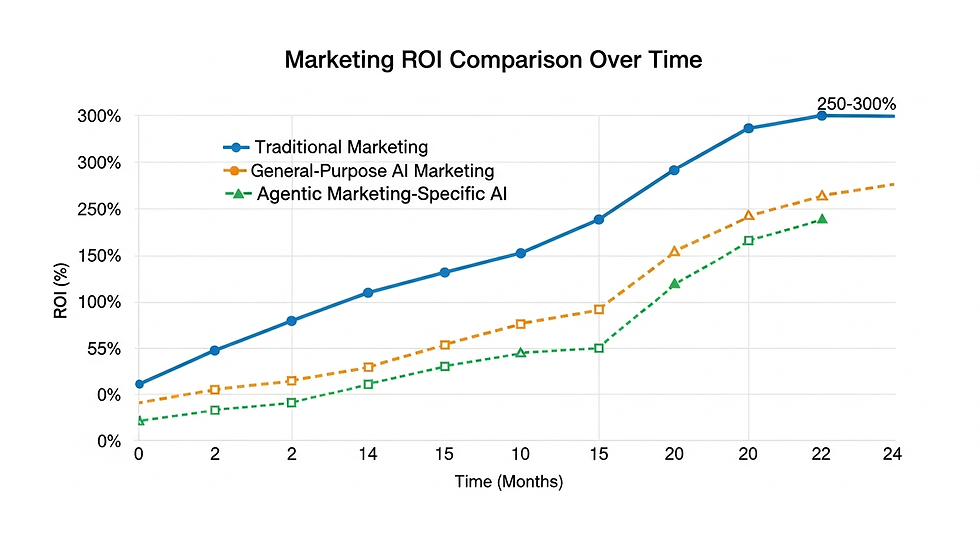
Cost efficiency represents another measurable advantage: companies using marketing-specific AI report 37% reduction in customer acquisition costs through AI-powered targeting that identifies high-value prospects more accurately than traditional methods or general-purpose AI recommendations. This improvement stems from specialized models that understand customer behavior patterns, competitive dynamics, and channel effectiveness at levels impossible for adapted general-purpose tools.
The elimination of agency fees and overhead provides additional ROI benefits for companies choosing autonomous marketing AI over traditional agency relationships or internal teams supported by general-purpose AI tools. Instead of paying 15-20% agency fees on media spend plus monthly retainers, companies using agentic marketing AI redirect those costs toward additional media investment while achieving superior performance through specialized optimization.
Consider the economic comparison for a company with $100,000 monthly marketing spend:
Traditional Agency Model:
$15,000 monthly agency fees
$85,000 media investment
2.1× ROI average performance
$178,500 monthly revenue generation
Net profit after agency fees: $63,500
Marketing-Specific Agentic AI:
$10,000 monthly AI platform cost (including 10% budget addition)
$110,000 total media investment
6× ROI through specialized optimization
$660,000 monthly revenue generation
Net profit after platform costs: $540,000
The ROI difference is 751% higher with specialized marketing AI, demonstrating why companies are rapidly adopting autonomous marketing systems that deliver measurable results rather than consulting services that generate reports.
Marketeam.ai clients experience 6× ROI by combining domain expertise with autonomous execution, proving that specialization plus autonomy equals measurable business impact rather than operational convenience. This performance stems from integrated optimization across all marketing functions—strategy development, creative creation, media buying, performance monitoring, and continuous optimization—handled autonomously by specialized AI agents rather than requiring human coordination and implementation.
The platform’s economic model aligns incentives with client success through budget addition rather than percentage fees. Instead of taking fees from your marketing investment, Marketeam.ai adds 10% to your budget and generates returns that far exceed the additional investment. This alignment ensures the platform focuses on improving actual performance rather than optimizing for billable hours or resource consumption.
Real-world case studies demonstrate consistent ROI patterns across industries and company sizes:
A SaaS company reduced customer acquisition cost from $450 to $180 while improving lead quality scores by 89% through specialized AI that optimized targeting, messaging, and funnel conversion rates simultaneously. The autonomous optimization identified high-value prospect characteristics that manual analysis and general-purpose AI tools had missed entirely.
An e-commerce retailer increased average order value by 156% while reducing cart abandonment rates by 43% through specialized AI that implemented dynamic product recommendations, personalized email sequences, and optimized checkout experiences based on real-time behavior analysis.
A professional services firm improved marketing-qualified-to-sales-qualified lead conversion by 234% through specialized AI that analyzed prospect engagement patterns and implemented targeted nurture sequences that general-purpose AI couldn’t design or execute autonomously.
The AI marketing sector grew from $15.8 billion in 2021 to $107.5 billion in 2025, driven by companies demanding ROI accountability rather than efficiency promises. This explosive growth reflects the market’s recognition that marketing AI must deliver measurable business results, not just operational convenience or cost reduction.
“After nine months using ChatGPT Plus and Claude Pro for our marketing team, we couldn’t identify any measurable ROI improvement. Three months with Marketeam.ai delivered 420% ROI increase and reduced our customer acquisition cost by 52%. The difference between AI suggestions and AI execution is the difference between expense and investment.” — CMO, B2B Technology Company
The evidence overwhelmingly supports a simple conclusion: marketing-specific AI delivers measurable ROI through autonomous execution and specialized optimization, while general-purpose AI adaptations consume resources without generating proportional business returns. The choice between these approaches determines whether AI represents a strategic advantage or an expensive experiment that fails to justify its costs.
With this ROI evidence clearly established, marketing leaders need a systematic framework for evaluating AI solutions that actually deliver results rather than consuming budgets without measurable business impact.
Evaluating AI Marketing Solutions: A Decision Framework
CMOs and marketing leaders face a critical decision point that will determine their competitive position for the next decade: choosing between AI tools that generate suggestions requiring human implementation versus autonomous AI systems that execute complete marketing workflows independently. This framework provides specific criteria for making strategic AI investment decisions that deliver measurable ROI rather than consuming resources without proportional business returns.
The Autonomy Test represents the most critical evaluation criterion: Can the solution execute complete marketing workflows without human intervention, or does it just generate suggestions requiring manual implementation, optimization, and management? This distinction separates true marketing AI from expensive suggestion engines that create more work rather than delivering autonomous results.
Evaluate autonomy by requesting specific examples: Can the AI develop campaign strategy, create content, implement across multiple channels, monitor performance, optimize based on real-time data, and scale successful approaches without requiring human prompts or intervention at each step? If the answer involves multiple “but you’ll need to…” qualifications, you’re evaluating an assistance tool, not an autonomous marketing solution.

Domain expertise assessment determines whether the AI understands marketing natively rather than adapting general knowledge for marketing tasks. Does the AI understand marketing-specific concepts like attribution modeling, customer lifetime value optimization, and marketing mix optimization as inherent capabilities rather than external additions requiring extensive prompting and explanation?
Test domain expertise through complex scenarios: Ask how the AI would optimize a multi-channel campaign for enterprise software sales, including account-based marketing coordination, sales alignment, and attribution across 12-month sales cycles. General-purpose AI will provide generic suggestions requiring extensive marketing expertise to evaluate and implement. Marketing-specific AI will demonstrate deep understanding of enterprise sales cycles, ABM strategies, and complex attribution challenges.
Integration capabilities separate platforms from tools by determining whether the AI can seamlessly connect with existing marketing tech stacks or operates as an isolated system requiring manual data transfer and coordination. Modern marketing requires unified data analysis across CRM systems, marketing automation platforms, advertising networks, and analytics tools.
Evaluate integration through practical requirements: Can the AI access real-time performance data from Google Analytics, Salesforce, HubSpot, LinkedIn Campaign Manager, and other critical platforms to make autonomous optimization decisions? Or does it require manual data exports, CSV uploads, and human interpretation of fragmented performance reports?
Real-time adaptation capabilities determine whether the AI responds automatically to market changes, competitor actions, and performance data, or requires new prompts and human analysis whenever conditions change. Marketing operates in dynamic environments where competitive advantages often last hours or days rather than weeks or months.
Test adaptation through scenario planning: How would the AI respond to a competitor launching aggressive pricing campaigns, algorithm changes affecting organic reach, or sudden shifts in customer behavior patterns? Autonomous marketing AI adapts strategies automatically based on real-time market intelligence. General-purpose AI tools require human recognition of changes, new prompts describing the situation, and manual implementation of suggested responses.
ROI accountability separates legitimate marketing solutions from experimental tools that consume budgets without delivering measurable business improvements. Can the vendor demonstrate specific ROI improvements with concrete metrics, or do they rely on vague “efficiency” claims and brand-building deflection that can’t be measured or verified?
Demand specific performance data: What customer acquisition cost improvements, conversion rate increases, and marketing-qualified lead generation improvements can be documented from existing implementations? Legitimate marketing AI vendors provide detailed case studies with measurable business metrics. Experimental tools focus on features, capabilities, and theoretical benefits that can’t be verified through performance data.
Economic alignment reveals whether vendors profit from your marketing success or extract fees regardless of performance outcomes. Do they add budget to your campaigns (like Marketeam.ai’s 10% addition model) or take percentage fees from your investment like traditional tools and agencies that profit whether your campaigns succeed or fail?
Analyze fee structures carefully: Performance-aligned vendors increase your marketing investment and generate returns that exceed the additional costs. Traditional vendors extract percentages from your existing budget, reducing actual marketing spend while adding overhead costs that must be justified through performance improvements they may or may not deliver.
The Agency Replacement Test provides the ultimate evaluation criterion: Ask whether the AI can handle strategy development, execution, optimization, and reporting end-to-end as a complete marketing solution. If the answer requires qualifications about human oversight, manual implementation, or external coordination, you’re evaluating an expensive assistant rather than a comprehensive marketing solution.
Compare capabilities systematically:
Evaluation Criteria | General-Purpose AI Tools | Marketing-Specific Agentic AI |
Strategic Planning | Generates suggestions requiring human analysis | Develops autonomous strategies based on business objectives |
Content Creation | Creates drafts requiring editing and optimization | Produces optimized content with built-in performance tracking |
Campaign Execution | Provides recommendations for manual implementation | Executes campaigns across multiple channels autonomously |
Performance Optimization | Suggests improvements based on static analysis | Continuously optimizes based on real-time performance data |
Attribution Analysis | Explains attribution concepts and provides templates | Implements sophisticated attribution modeling automatically |
Competitive Intelligence | Offers general competitive analysis frameworks | Monitors competitors continuously and adjusts strategies accordingly |
Vendor credibility assessment should focus on marketing-specific achievements rather than general AI capabilities. Has the vendor demonstrated measurable success specifically in marketing contexts, or are they adapting general-purpose technology for marketing applications?
Research vendor backgrounds: Marketing AI leaders have deep marketing expertise combined with specialized AI development, evidenced by detailed comparisons with established marketing platforms and specific differentiation from content generation tools. General-purpose AI companies adapting their tools for marketing lack domain-specific credibility and proven marketing performance.
The evaluation framework ultimately determines whether AI will replace traditional marketing approaches through superior performance or simply add complexity and cost without proportional business benefits.
“We evaluated 12 different AI marketing solutions using this framework. Only one passed all criteria for autonomy, domain expertise, integration, real-time adaptation, ROI accountability, and economic alignment. The others were expensive tools requiring more human oversight than traditional marketing methods.” — VP Marketing, Enterprise Manufacturing Company
The decision framework reveals a fundamental truth: most AI marketing solutions are sophisticated suggestion engines that require extensive human implementation and oversight, while true marketing AI operates autonomously to deliver measurable business results without human intervention overhead.
This framework reveals why the future of marketing belongs to purpose-built AI that delivers ROI accountability through autonomous execution, not adapted general-purpose tools that generate suggestions requiring human analysis and implementation.

Conclusion
The choice between general-purpose AI and marketing-specific agentic AI isn’t about technology preferences—it’s about ROI accountability that determines competitive survival in an increasingly AI-driven marketplace. While ChatGPT, Claude, and Gemini excel at general tasks, they fail in marketing’s complex, real-time environment where autonomous execution and domain expertise separate winners from companies that consume resources without generating proportional business returns.
The evidence overwhelmingly supports a fundamental shift toward specialized solutions. Companies implementing marketing-specific AI report 300% average ROI through autonomous optimization that operates continuously without human intervention overhead. Meanwhile, organizations relying on adapted general-purpose tools struggle to prove value beyond operational convenience, spending resources on prompt engineering and manual implementation that could be directed toward media investment and business growth.
Marketing-specific AI models like Marketeam.ai’s proprietary platform deliver measurable results: 6× ROI through specialized knowledge, autonomous execution, and true accountability that aligns vendor success with client business outcomes. Instead of extracting fees regardless of performance, specialized marketing AI adds budget to campaigns and generates returns that far exceed additional investment through superior optimization and autonomous execution.
The competitive implications are stark: while companies debate whether to adapt ChatGPT or Claude for marketing tasks, their competitors using purpose-built marketing AI are achieving 37% customer acquisition cost reductions, 156% average order value increases, and 234% lead conversion improvements through autonomous optimization that operates 24/7 without human oversight requirements.
The window for competitive advantage is closing rapidly as the AI marketing sector continues explosive growth driven by companies demanding ROI accountability rather than efficiency promises. Organizations that choose specialized marketing AI now will establish sustainable competitive advantages that companies using adapted general-purpose tools cannot overcome through better prompting strategies or additional human resources.
The transformation extends beyond tool selection to fundamental business model evolution. Traditional agencies promise 6× ROI but rarely deliver measurable business results, focusing on creative awards and brand metrics that don’t correlate with revenue growth. Purpose-built marketing AI delivers the performance accountability that agencies promise, with economic models aligned for long-term client success rather than short-term revenue extraction.
The question isn’t whether AI will transform marketing—it’s whether you’ll choose tools that deliver measurable ROI or settle for expensive experiments that promise everything and deliver excuses. Companies implementing specialized marketing AI achieve competitive advantages that compound over time through continuous autonomous optimization, while those relying on adapted general-purpose tools fall further behind despite significant technology investments.
The marketing landscape rewards accountability, performance, and results. General-purpose AI tools consume resources while generating suggestions that require human implementation and optimization. Marketing-specific agentic AI delivers autonomous execution that improves performance continuously without human intervention overhead, translating directly into measurable business improvements that justify AI investments through concrete ROI metrics.
Experience the 6× ROI Difference
The difference between AI suggestions and AI execution determines whether your marketing AI investment delivers competitive advantage or consumes resources without proportional business returns. Marketeam.ai’s agentic Integrated Marketing Environment doesn’t just assist your marketing—it executes complete campaigns autonomously while delivering the ROI accountability that traditional agencies promise but never provide.
Instead of adapting general-purpose tools for marketing tasks, experience purpose-built AI that understands marketing natively and operates autonomously to optimize performance continuously. While competitors struggle with prompt engineering and manual implementation, you’ll achieve measurable business results through specialized AI agents that handle strategy development, creative optimization, campaign execution, and performance improvement without requiring human oversight at every step.
Ready to see 6× ROI from AI that actually understands marketing reality? Schedule your Marketeam.ai demonstration and discover why purpose-built marketing AI delivers the competitive advantages that adapted general-purpose tools can never provide.
Because when it comes to marketing ROI, we don’t make promises—we deliver results.

Comments