AI SEO tools are everywhere. Genuine AI SEO agents are not. The difference is whether a system simply generates recommendations, or can make decisions, execute across the SEO workflow, and learn from the results.
AI SEO Agents: How Autonomous Agents Handle Search in 2026
Ninety-six percent of chief marketing officers say AI is driving end-to-end transformation of their function. Roughly eight percent are actually running campaigns where multiple agents operate autonomously. Both figures come from the same study — BCG’s June 2026 survey of 300 global CMOs — and the distance between them is the most honest picture of the market anyone has published this year.
Near-universal intent. Near-zero execution.
The gap has a cause, and it is not budget. Most of what gets sold as an AI SEO agent in 2026 is a keyword research platform with a text-generation button bolted onto the side. It surfaces data. It drafts copy on request. It produces a tidy list of recommendations that a human then has to read, prioritise, sequence, and implement. Nothing in it sets a goal. Nothing in it chooses a path. Nothing in it looks at what happened to last quarter’s publishing decisions and adjusts this quarter’s plan accordingly.
That is not autonomy. That is a faster way to generate homework.
This post takes a different approach to the topic than most. Rather than defining agentic SEO in the abstract and gesturing at a transformed future, it walks the actual workflow — query discovery, SERP analysis, gap and cannibalisation detection, planning, drafting, internal linking, publishing, and measurement — and marks, at every stage, what an agent genuinely decides versus what it merely executes. There is a full section on what still requires a human, and it is not a token disclaimer. If you have been oversold on autonomous SEO before, that section is the reason to keep reading.
One frame carries the entire piece, so it is worth stating plainly at the top. Search is not a task queue. It is a competitive game, played in real time against other people who are also optimising, scored on signals that arrive late and arrive blended. Every architectural argument in this post follows from that single observation. If you want the wider view of how AI agents for marketing operate across the whole function rather than just search, that context sits alongside this piece. (editor: repoint to the hub guide at publish)
Before walking the workflow, though, we need a definition sharp enough to separate the real thing from the marketing around it.

What an AI SEO Agent Actually Is — and Three Things It Isn’t
The word agent has been applied to so many products in the past eighteen months that it has almost stopped carrying information. A useful definition has to describe behaviour, not branding — something you can hold up against a demo and get a yes or a no.
Four tests do most of the work.
It decomposes objectives into its own sub-goals. Give it “grow qualified organic traffic for the mid-market segment” and it derives the intermediate targets itself: which clusters to build, which existing pages to consolidate, what order to work in. A system that requires you to specify the sub-goals is being operated, not operating.
It selects and uses tools without a human choosing each one. Crawlers, indexing APIs, analytics platforms, the CMS, rank data, log files. The agent decides which instrument the current question calls for. If a person picks the tool and the model fills in the blanks, the intelligence is in the person.
It acts under uncertainty and revises. SEO decisions are made on incomplete information, always. An agent commits to a course of action knowing it might be wrong, then updates when evidence arrives.
It closes the loop on delayed feedback. This is the hardest test and the one most systems fail. Producing an output is not the end of the job. Watching what that output did to rankings eight weeks later, and letting that observation change the next decision, is the job.
Systems that fail these tests are not useless. They are just not agents. Three categories currently borrow the label, and distinguishing them is the difference between buying capability and buying vocabulary.
Category one: an SEO platform with an AI feature attached
The rank tracker that now writes meta descriptions. The audit crawler with a “generate fix suggestions” button. The content brief builder that drafts an outline.
These are genuinely useful products, and the feature usually works. But notice where the intelligence sits: inside one feature, bounded by one screen. The workflow between features remains entirely human. You run the audit, read the output, decide what matters, open a different module, generate a draft, paste it somewhere else, and remember to check back in six weeks.
The output type is suggestions. Every suggestion is an invoice for human attention.
Category two: scripted automation
Rules and triggers. When a page drops below position ten, send an alert. When a title tag exceeds sixty characters, flag it. When a URL 404s, add it to a report. Publishing pipelines that push content on a schedule.
This is legitimately valuable engineering, and most mature SEO operations run some version of it. It is also emphatically not agentic. A script cannot invent a step nobody wrote. Confront it with a situation outside its conditional logic and it does not adapt — it fails, often silently, which is worse than failing loudly. When the SERP changes shape and the assumptions behind the rule stop holding, the rule keeps firing with perfect confidence and zero relevance.
The output type is execution without judgment.
Category three: a genuinely agentic system
Sets its own sub-goals from a stated objective. Sequences its own work. Combines tools rather than operating them one at a time. Treats last quarter’s ranking movement as an input to this quarter’s plan rather than as a report to be filed.
The output type is decisions.
That word is not incidental. Gartner research published on 18 May 2026, titled CMOs: Ensure Marketing Decisions Are Ready for Agentic AI, lands on exactly this framing:
To unlock AI value, CMOs must redesign marketing around decisions, not tasks.
The three-category split above is the tasks-versus-decisions line, applied to search specifically. Category one accelerates tasks. Category two automates tasks. Only category three makes decisions — and only category three changes what your team is capable of rather than how fast it types.
Why the distinction matters more in search than almost anywhere else
Here is the structural point underneath all of this, and it is the reason a generic model pointed at SEO underperforms even when the model itself is excellent.
General-purpose language models were trained to complete linear tasks with immediately evaluable output. Summarise this. Translate that. Draft an email. The task has a beginning, an end, and a quality judgment available within seconds.
Search has none of those properties. It is non-linear — the same objective can be reached through a dozen different content and architecture paths, and the right one depends on where your site already has authority. It is opponent-driven — every competitor is optimising against the same queries, and their moves change the value of yours. It is multi-path and reversible — decisions compound, and some of them are expensive to unwind. And it is scored on delayed, aggregated signals — you will not know whether last month’s consolidation worked until several weeks of data accumulate, by which point four other variables have also changed.
Marketing, in other words, behaves like a strategy game. This is a claim we have made at length in our analysis of why marketing-specific models behave differently from general-purpose ones, and search is where it is most obviously true.
It is also why the distinction between an autonomous co-worker and an assistive layer is not semantic hair-splitting. We have argued before that the right mental model is an AI co-worker rather than a co-pilot — something that owns outcomes rather than accelerating keystrokes. In search, where the work is continuous and the feedback is slow, that difference compounds over months.
So much for definitions. The useful question is what an agent actually does when you put it to work.
The End-to-End SEO Workflow an Agent Can Run in 2026
What follows is the complete search workflow, stage by stage. For each one: what happens, what the agent decides on its own, and where a human still has to be in the room. The honesty at each stage matters more than the enthusiasm — the stages where autonomy is weak are as informative as the ones where it is strong.
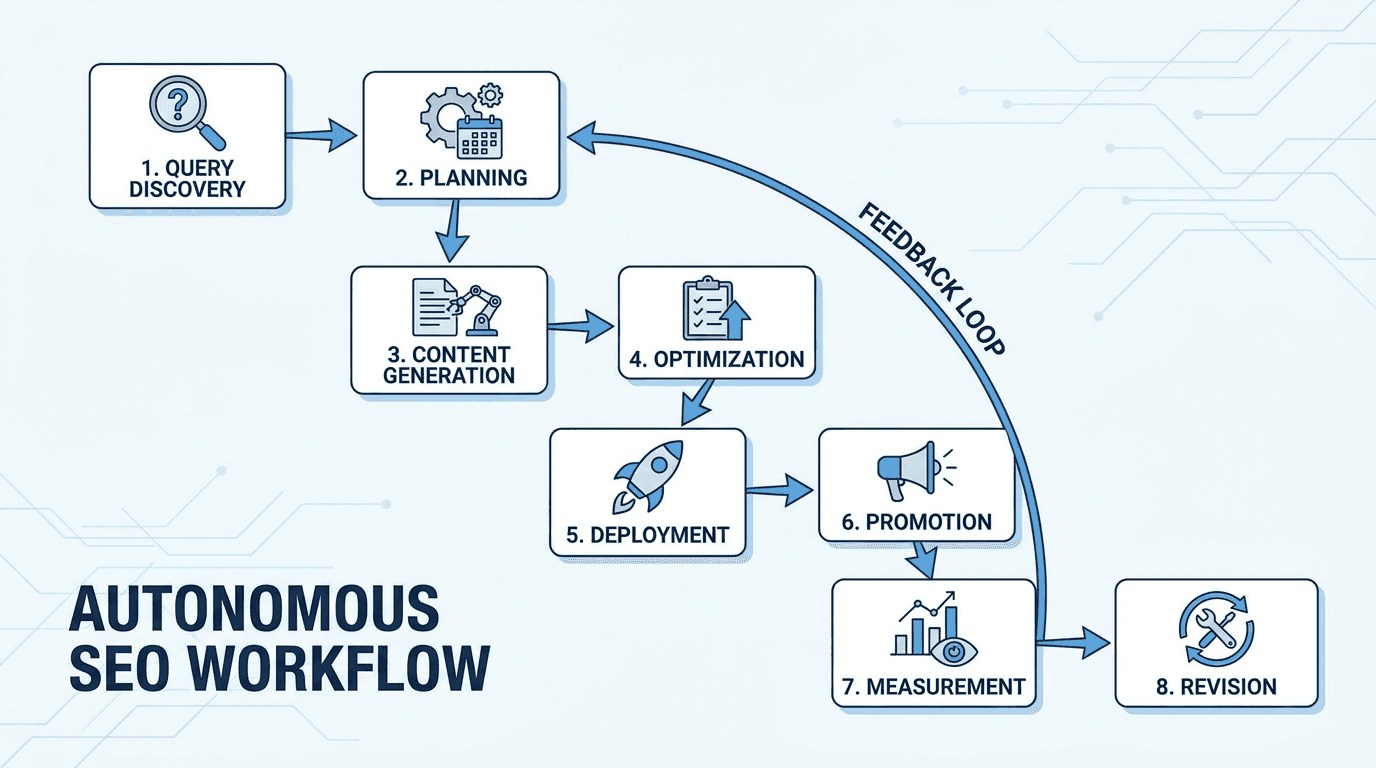
Note the feedback loop in that diagram returning from measurement to planning. It is not decoration. A pipeline that runs discovery to publication and stops is a content factory, however sophisticated its components. The loop is what makes the system agentic. Everything else is throughput.
For readers who want the underlying discipline rather than the agentic layer on top of it, our guide to what SEO is and how ranking actually works covers the foundations these stages are built on.
Query and demand discovery
The starting point is not a seed keyword list. It is a map of demand.
Traditional keyword expansion takes a seed term and returns strings that resemble it. That produces volume, not understanding. Agentic discovery clusters by intent rather than string similarity, which means recognising that two queries sharing no vocabulary might belong to the same page, while two near-identical phrases might need entirely separate treatment because the people typing them want different things.
It also means catching demand before the tools do. Keyword volume data is retrospective by construction — a query needs history before it gets a number. Emerging queries, especially around new product categories and new terminology, are invisible in volume data precisely when they are cheapest to win. An agent monitoring query surfaces continuously can identify a rising pattern from its shape rather than waiting for a monthly index refresh to confirm it.
The third element is question-shaped demand. Queries phrased as questions feed AI-generated answers, and they behave differently from head terms: lower individual volume, far higher aggregate coverage, and disproportionate influence on whether a brand appears inside generated responses.
The agent decides: which clusters justify investment given the site’s current authority. A cluster is not attractive because it has volume — it is attractive because there is a realistic path from where the domain stands today to competing in it. That calculation is a judgment about relative position, and it is exactly the kind of thing a system with full site state can make and a spreadsheet cannot.
The human intervenes: whether a cluster belongs to the brand at all. An agent can prove a topic is winnable. It cannot decide whether winning it is consistent with what the company wants to be known for.
SERP and competitive landscape analysis
This is the opponent-modelling stage, and it is where the strategy-game framing becomes concrete rather than rhetorical.
The first question is not “who ranks?” but “how much of this page is organic at all?” A query where an AI-generated answer, a pack of product listings, a video carousel, and a set of related questions occupy the visible area before the first blue link is a fundamentally different commercial proposition from one where ten organic results start near the top. Same volume, different economics entirely.
The second question is what format the results page is rewarding. When comparison pages dominate, that is a signal about intent that no keyword tool will hand you. When results skew toward short definitional content, a four-thousand-word guide is the wrong instrument regardless of quality.
The third is movement over time. Static competitive analysis is a photograph. What matters is the direction: which rivals are expanding coverage into your clusters, which are retreating, where new entrants are gaining ground. Rankings are relative. Your page can improve while your position declines, because someone else improved faster.
The agent decides: format and depth targets for each query, derived from what the SERP is currently rewarding rather than from a house style guide.
The human intervenes: competitive positioning claims. How you characterise rivals is a business and legal question with a business owner.
Keyword-gap and cannibalisation detection
This is where agents outperform humans decisively, and the reason is unglamorous: it is a combinatorial comparison problem, not a creative one. Every URL against every other URL, across overlapping query sets, ranking histories, and intent signals. The comparison count grows quadratically with site size.
Humans do not do this well, not because it is intellectually difficult but because it is enormous and tedious. Machines do it well for the same reason. This stage gets a dedicated section below, because the wins are the most demonstrable in the entire workflow.
Content planning and briefing
Turning clusters into a plan means answering four questions: what to publish, what to consolidate, what to retire, and — critically — in what order.
Sequencing is the part that gets treated as administration and is actually the most consequential decision in the stage. Topical authority accumulates. Publishing a cluster’s supporting pages before its central page is a materially different outcome from the reverse, and on a large site, crawl budget makes the ordering consequential in a second way. Publishing forty pages in a week on a domain with a modest crawl allocation means most of them wait.
A plan that lists forty pieces of content with no defensible order is not a plan. It is a backlog with ambition.
The agent decides: sequencing, consolidation targets, retirement candidates, and the dependency order between them.
The human intervenes: commercial priority when it conflicts with the modelled optimum, which it sometimes should.
Drafting and on-page construction
Time for an unfashionable admission: drafting is the most commoditised stage in this workflow and the least differentiating.
Text generation is essentially solved as a capability and available everywhere. If your evaluation of an AI SEO agent centres on prose quality, you are evaluating the least distinctive thing it does.
The value is in the constraints, not the generation. Does the draft cover the entities the topic requires, or only the keywords? Does it carry its internal-link obligations — linking to the right pages, with anchor text that does not shred the site’s anchor distribution? Is the schema correct and consistent with what is visible on the page? Does the format match the intent the SERP analysis identified, rather than defaulting to the house template?
Those constraints are only enforceable if the drafting stage has access to the site’s full state. A generation step that does not know what else exists on the domain will happily produce a page that competes with three of your own.
Internal-link architecture
This stage is badly under-served in most writing on the subject, and it is where the whole-site-state argument becomes tangible.
An agent can hold the entire link graph in working context. Not a sample. Not the top hundred pages. The graph. From that vantage point, several things become visible at once that are effectively invisible from inside a CMS:
Orphaned and near-orphaned pages — content receiving no internal links, or only one from a low-authority page, quietly starved of both equity and crawl attention.
Over-linked hubs — pages absorbing hundreds of internal links and passing diluted value onward, where the concentration is habit rather than strategy.
Anchor-text distribution — whether inbound anchors describe a page consistently, or whether the same URL is described five contradictory ways.
Shortest paths from authority to need — which strong pages could link to which weak-but-commercially-important ones, and how few hops the site currently allows.
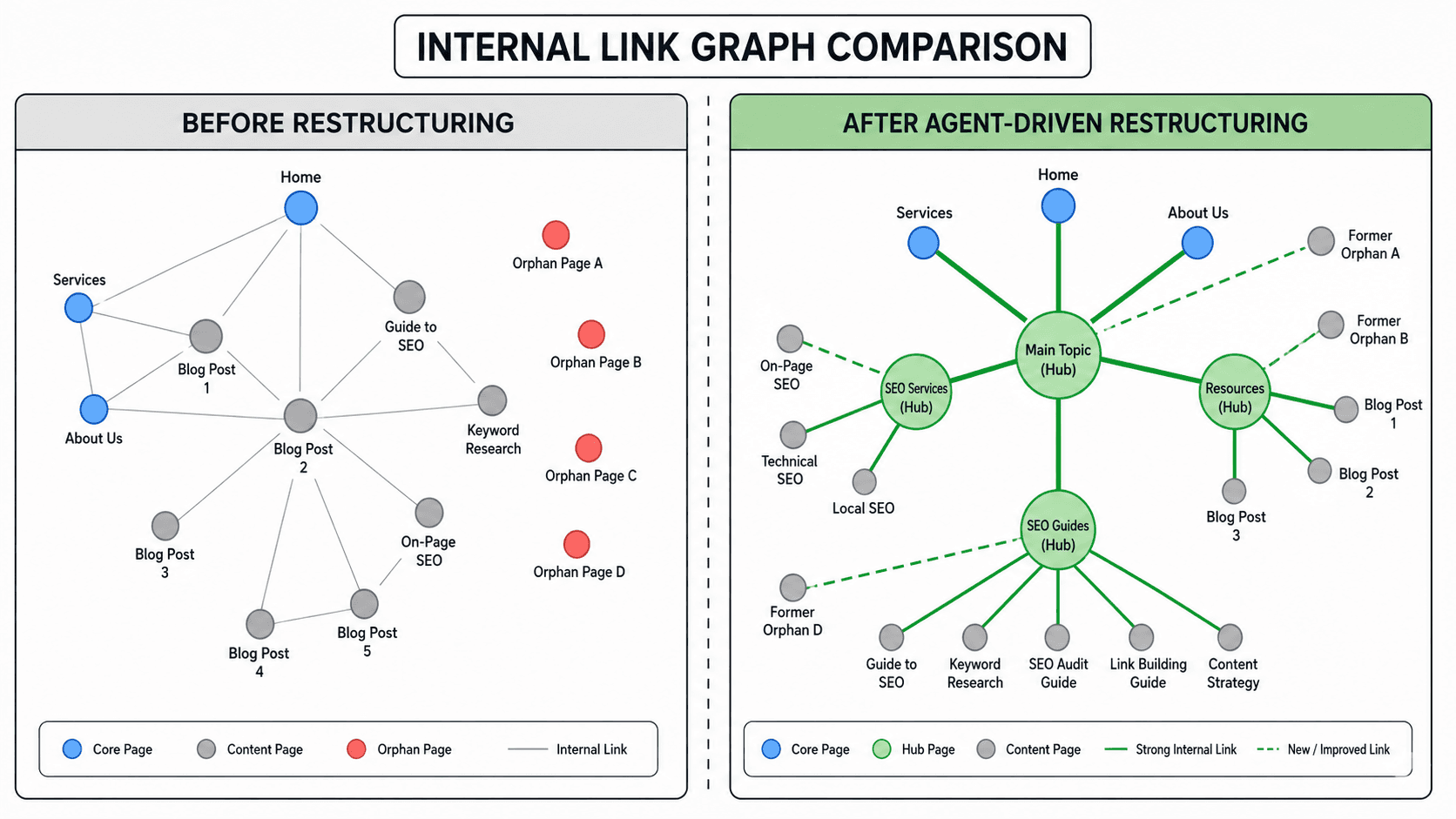
Here is the part worth sitting with: almost no team does this at whole-site scale, and the reason is not that it is intellectually hard. It is that it is boring and it never ends. Every new page changes the graph. Every retired URL leaves holes. Doing it properly means redoing it continuously, which is precisely the shape of work that suits an autonomous system and exhausts a human one.
The agent decides: link placement, anchor variation, and priority order for equity redistribution.
The human intervenes: rarely, and mostly on navigational and brand-hierarchy questions.
Publishing and technical execution
CMS integration, scheduling, indexing requests, structured data validation, redirect management. Mechanically straightforward, operationally where a great deal of SEO value quietly leaks away.
One clarification worth having correct, because folklore has outrun documentation: according to Google’s guidance on AI features and your website, no special structured-data markup is required for content to appear in AI experiences. Markup remains useful for the reasons it has always been useful — but any structured data used must match the content visible on the page. Marking up content that is not there is a validation failure, not a shortcut.
The agent decides: publication timing, indexing prioritisation, and markup implementation.
The human intervenes: approval gates on anything with legal or brand exposure.
Measurement and revision
The loop closes here, and it is difficult enough to warrant its own section further down. The short version: this is the stage that separates a content pipeline from an agent, and it is the stage most systems skip.
This is the workflow that Marketeam.ai’s dedicated SEO agent runs in production, which is why this account is written in operational rather than speculative terms.
Two stages in this workflow produce the clearest, most demonstrable wins — and they are worth watching in close-up.
Cannibalisation Detection and Striking-Distance Refreshes: Agentic SEO in Practice
Abstractions about autonomy are easy to nod along with and hard to act on. These two patterns are the opposite: narrow, concrete, and immediately recognisable to anyone who has managed a content site for more than two years.
Why cannibalisation is an agent-shaped problem
Keyword cannibalisation is what happens when several pages on the same domain compete for the same query. Search engines pick one, the choice is unstable, and authority that should have concentrated on a single strong page spreads thin across three mediocre ones.
The detection problem is combinatorial. Confirming a site is free of cannibalisation means comparing every URL against every other URL across overlapping query sets, ranking histories, and intent signatures. On a site of eight hundred pages that is hundreds of thousands of pairwise comparisons, each requiring judgment about whether the overlap is genuine competition or legitimate differentiation.
Which is why, in practice, most teams find cannibalisation the same way: by accident, months after it started costing them, usually while investigating something else.
Most teams don’t detect cannibalisation. They stumble into it — quarters late, mid-way through an unrelated audit, after the traffic has already gone.
Continuous whole-site comparison is a machine-shaped task in the purest sense. No creativity required, considerable scale required, and it needs redoing every time anything changes.
A worked example — illustrative, not client data
The following is a constructed illustration to show the decision chain. The numbers are invented for clarity and do not represent any client’s results.
A B2B software company has three published pages, written eighteen months apart by three different people:
A 2024 blog post: “How to Choose Invoice Automation Software”
A 2025 comparison page: “Best Invoice Automation Tools for Finance Teams”
A 2026 guide: “Invoice Automation: A Complete Buyer’s Guide”
All three target close variations of the same commercial query. Rankings oscillate between them month to month — position nine, then fourteen, then eleven — as the engine keeps reconsidering which page best answers the query. None accumulates durable authority. Combined, they underperform what one consolidated page would achieve, and nobody notices because each individually looks like it is doing something.
The agent’s decision chain:
Detect the overlap. Three URLs, substantially shared query set, oscillating positions — the signature pattern.
Distinguish genuine competition from legitimate differentiation. Do these pages serve meaningfully different intents? Here, no. All three serve an evaluation-stage buyer.
Identify the strongest survivor. Which URL has the best external link profile, longest indexed history, and strongest engagement? Not necessarily the newest or best-written one — link equity and history carry weight that fresh prose does not.
Choose consolidation over differentiation. Sometimes the right answer is to sharpen two pages toward distinct intents instead of merging. Here, consolidation wins.
Redirect the retired URLs to the survivor, preserving equity.
Rewrite the survivor to absorb the unique value from the retired pages — the comparison table from one, the process detail from another.
Update every internal link that pointed at the retired URLs so they point at the survivor directly rather than through a redirect hop.
The important detail is step ordering. Redirect before rewriting and you lose the source material. Rewrite before updating internal links and the link graph points at a page whose purpose has shifted. Retire pages before confirming which has the strongest profile and you may have just deleted your best asset.
The sequence is itself a decision. That is the agentic part. Any competent audit lists the three URLs. Knowing what to do in what order, and executing it without dropping a step, is different work.
For readers newer to this territory, our primer on keyword-level fundamentals covers the groundwork this analysis assumes.
Striking-distance refreshes and the prioritisation problem
The second pattern is simpler and easier to underestimate.
Pages ranking in positions eight to twenty occupy an awkward middle: enough authority to be taken seriously, not enough to earn meaningful traffic. Click-through distribution across the results page is steep, so movement from position eleven to position five produces a disproportionate traffic change relative to the effort involved.
Every SEO knows this. Striking-distance reports have been a standard feature for a decade. So why do agents win here?
Not cleverness. Continuity.
A quarterly audit catches a page that slipped from six to twelve at some unknown point in the preceding ninety days. Continuous monitoring catches the slip within days, while the cause is still identifiable and the page still has momentum. The advantage is not analytical sophistication. It is that the observation happens every day instead of four times a year.
But the genuinely agentic part is not the list. It is the choosing.
Any tool can produce a hundred striking-distance URLs. Deciding which five to work on this month is a multi-variable judgment: commercial value of the query, competitive difficulty of the current top five, the page’s existing authority, effort required, and how the refresh interacts with everything else in the plan. That judgment — repeated monthly, informed by what the previous month’s choices actually produced — is the decision layer.
Grounding those decisions in Google’s guidance on optimising for generative AI features matters more than it used to, because what constitutes an improvement has broadened beyond keyword coverage.
Two failure modes worth naming
Candour about where these patterns break is more useful than another paragraph of advocacy.
False-positive cannibalisation flags. Two pages targeting similar queries sometimes should both exist, because they serve genuinely different intents that a query-overlap analysis flattens. An informational explainer and a product comparison page can share vocabulary while serving different people at different stages. Consolidating them on the strength of a similarity score destroys value. This is why intent classification, not string overlap, has to drive the decision — and why edge cases warrant human review.
Refreshes that reset performance history. A page with two years of accumulated signal is not a blank slate. Aggressive rewriting can reset that. Sometimes the correct answer is a targeted intervention — improved introduction, added section, updated data — rather than a wholesale rebuild. Systems that treat every striking-distance page as a rewrite candidate will occasionally damage pages that were quietly working.
Both patterns share an assumption, and it is one that is eroding: that the goal is a position on a page of ten blue links. Increasingly, a large share of search never produces a click at all.
AEO, AI Overviews, and Optimising for LLM Answers
The fastest-moving dimension of search is also the least well covered in most writing about SEO automation — usually appended as a closing paragraph about “the rise of AI search.” It deserves considerably more than that, because it is the single strongest argument for continuous autonomous monitoring.
What actually changed
For twenty-five years the objective was stable: occupy a position in a ranked list, and receive a share of clicks determined by that position.
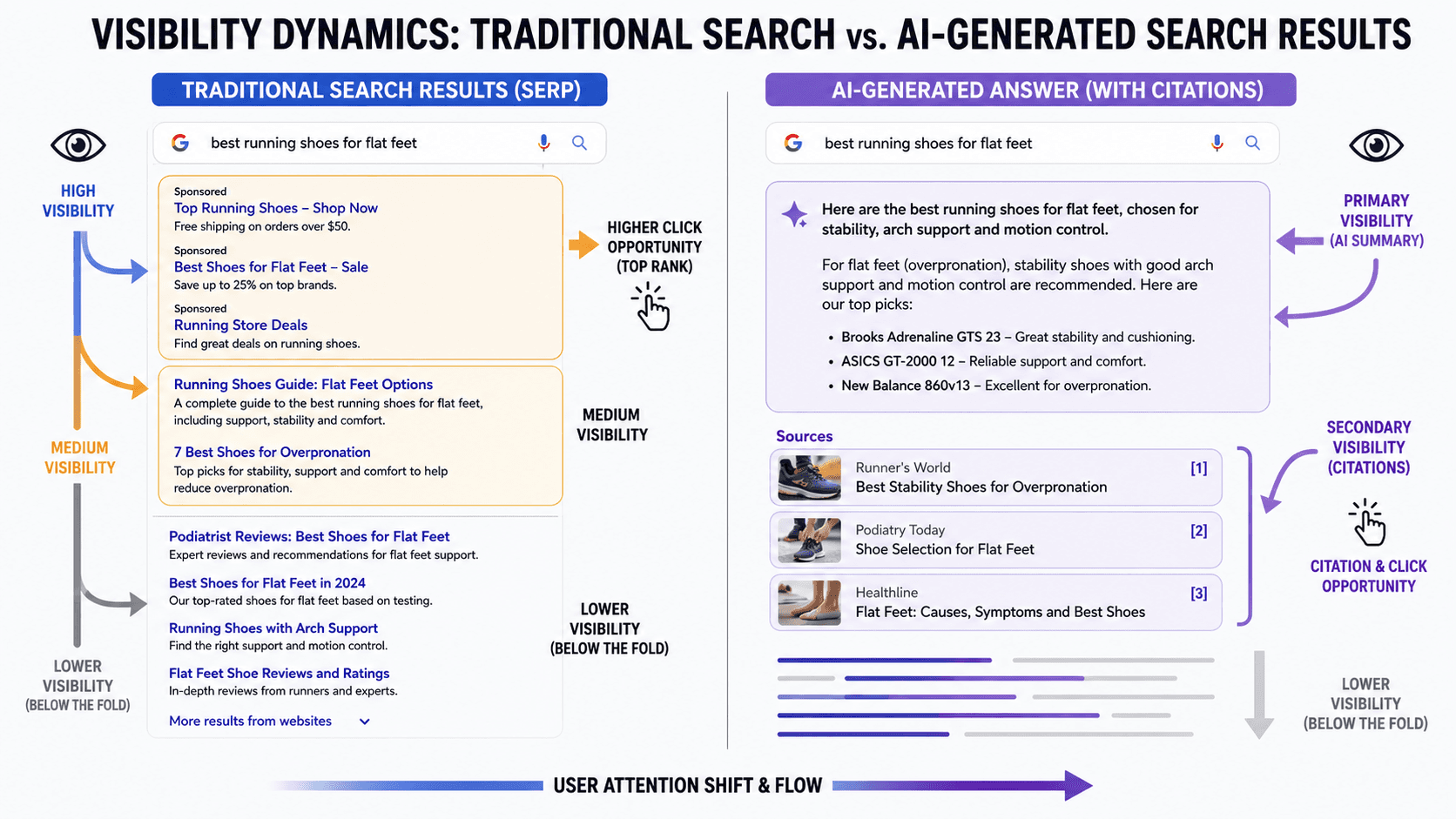
That objective still exists. It is no longer the only one. A growing share of queries return a generated answer that synthesises information from multiple sources, cites some of them, and satisfies the user without a click. The goal shifts from holding a position to being the answer, or being cited within it.
This is the territory of answer engine optimisation (AEO) and generative engine optimisation (GEO). Different labels, same underlying question: how does a brand remain visible when the interface between a person and the web is a synthesis rather than a list?
We have been tracking this shift since AI Overviews first appeared, and our earlier analysis of whether SEO is dead and what AEO and AIO mean for marketers called the direction before it became consensus.
What Google actually documents
This subject attracts more speculation per square inch than any other area of SEO. So it is worth being disciplined and stating only what is documented, from Google’s own guidance on AI features and your website:
Pages must be indexed and eligible for snippets to appear in AI experiences. Eligibility is the foundation; nothing else matters without it.
There are no additional technical requirements specific to AI Overviews or AI Mode beyond standard indexability.
No special schema.org markup is required. Structured data remains valuable for other reasons, but there is no secret AI-specific markup. Any structured data used must match visible content.
Preview controls govern what can surface.
nosnippet,data-nosnippet,max-snippet, andnoindexall affect what can appear in AI experiences. Restricting snippets restricts AI visibility — a genuine trade-off worth making deliberately rather than inheriting from a legacy configuration.
Google’s guidance on succeeding in AI search reinforces the same principle: the fundamentals of useful, well-structured, technically accessible content remain the mechanism. There is no separate AEO checklist that bypasses content quality.
The pace problem
AI Mode was introduced and expanded through 2025. On 27 January 2026, Google announced that Gemini 3 became the default model for AI Overviews globally.
Sit with the operational implication. The model generating answers across a large share of the world’s search queries changed. Not the ranking algorithm — the synthesis layer that determines how information is framed, which sources are drawn on, and how answers are constructed.
A team on a quarterly SEO review cycle might notice the effects six weeks later, in aggregate, as unexplained variance in traffic. By then the surface has moved again.
This is the structural argument for continuous monitoring, and it has nothing to do with vendor preference. The observation cadence has to match the change cadence. Quarterly audits against a surface that changes monthly is not a strategy — it is a lag.
What an agent actually does for AEO
Concretely, and without overstatement:
Monitors which queries trigger AI answers across the tracked query set, and whether that composition is shifting.
Tracks brand citation within those answers — whether the brand appears, in what context, and how that changes over time.
Structures content into extractable units. Self-contained definitions, direct question-and-answer blocks, clearly delimited lists. Content that can be lifted and cited without surrounding context is content that gets lifted and cited.
Maintains entity coverage and consistency. Generated answers are built on entity relationships. Whether a brand is consistently associated with the right concepts across the web is a tractable, monitorable property.
Detects framing shifts. When an AI answer’s characterisation of a topic changes — a new sub-question surfacing, a different aspect emphasised — that is a signal that specific content needs revisiting. Catching it in days rather than quarters is the entire value.
Flags eligibility regressions. A snippet directive added during an unrelated site update can silently remove pages from AI experiences. This is a boring failure mode that costs real visibility.
The brand’s AEO and GEO agent runs this monitoring alongside the SEO workflow described above, sharing the same site state — which matters, because AEO decisions that ignore the underlying content architecture are guesswork with better vocabulary.
The honest ceiling
Now the part most content on this topic omits.
Citation behaviour inside AI answers is substantially less observable than classical rank tracking. Rankings are enumerable: you can check position for a query and get a deterministic answer. AI answers are generated, vary by context and phrasing, and do not expose a public ranked list of considered sources.
Anyone claiming deterministic control over AI Overview inclusion is overselling. The honest position: an agent provides systematic coverage and fast detection of change. It ensures content is eligible, well-structured, entity-consistent, and monitored. It cannot guarantee placement, and any system promising otherwise is describing a mechanism that has not been documented by anyone in a position to document it.
Which raises the question this section makes unavoidable. If visibility increasingly happens without clicks, how do you evaluate whether any of this is working?
Measuring an AI SEO Agent When the Feedback Is Delayed and Aggregated
This is the hardest problem in autonomous SEO and the least discussed. It is also where the strategy-game thesis stops being a metaphor and becomes an engineering constraint.
Why SEO measurement is structurally harder than it looks
Three properties make search feedback uniquely difficult, and they compound.
It is delayed. Publish today, and meaningful ranking signal takes weeks. Consolidate a cluster, and stabilisation takes longer still. The gap between decision and evidence routinely runs eight to twelve weeks.
It is aggregated. During those weeks you did not make one change. You published eleven pages, refreshed six, restructured internal links, and fixed a crawl issue. Traffic moved. Attributing that movement to any single decision is guesswork dressed as analysis.
It is contaminated. Seasonality. Algorithm updates. Competitors publishing. A rival’s site migration handing you rankings you did nothing to earn. The signal arrives blended with noise you did not generate and cannot isolate.
You rarely get a clean read on any individual decision. Ever.
Why this breaks conventional AI evaluation
Standard evaluation of a language model scores output quality directly. Was the summary accurate? Was the translation correct? The judgment is available immediately and correlates with the thing you care about.
An AI SEO agent produces output whose value is unknowable for two to three months. You can assess whether a draft reads well, covers its entities, and carries correct markup — but that assessment is a proxy. A page can be excellent by every observable quality measure and fail commercially because the cluster was wrong, the timing was wrong, or a competitor was better positioned.
Output quality is a proxy. It is never the score.
Systems built for immediate-feedback tasks have no native mechanism for learning from a signal that arrives eight weeks after the action. That is not a tuning deficiency. It is an architectural one.
A layered measurement model
The practical answer is to stop looking for one number and instead measure at three time horizons, with a fourth discipline holding it together.
Leading indicators (days). Fast, directly attributable, but weakly correlated with commercial outcomes. Indexation status of new pages. Crawl frequency changes. Internal-link coverage — orphan count, average path depth from authority pages. Structural completeness: schema validity, entity coverage against topic requirements. These confirm the machinery is working. They do not confirm it is working on the right things.
Intermediate indicators (weeks). The most useful layer, and the most neglected. Impression growth in search performance data. Average position movement across the target set. Query-set expansion — the number of distinct queries a page appears for, which often moves before position does and is a genuine early warning. Striking-distance population shifts: is the eight-to-twenty band growing or draining?
Lagging indicators (months). What the business cares about. Qualified organic sessions. Assisted conversions. Revenue attribution. Real, slow, and heavily contaminated.
Counterfactual discipline (continuous). This is where most SEO measurement quietly falls apart. Without a holdout — a deliberately untouched set of comparable pages — you cannot separate agent effect from sitewide movement. If organic traffic rises fourteen percent and every page was touched, you have learned nothing about causation. If it rises fourteen percent on treated pages and three percent on a matched holdout, you have learned something worth acting on.
Holdouts feel wasteful. They are the only mechanism that turns SEO measurement from narrative into evidence.
The measurement surface has expanded
One concrete development most competing content has not caught up with: Google Search Console now includes reporting on appearances in AI experiences, covering AI Overviews and AI Mode, as documented in Google’s AI features guidance.
This matters because it converts part of AI visibility from anecdote into data. It does not make citation behaviour fully observable — the ceiling described earlier still applies — but it provides a first-party surface where previously there was only inference.
Measure decisions, not activity
Return to the Gartner framing, because it applies with full force here:
To unlock AI value, CMOs must redesign marketing around decisions, not tasks.
If you evaluate an agent on volume of tasks completed — pages published, briefs generated, issues flagged — you will get an enormous volume of tasks completed. Systems optimise for what they are scored on. Content volume is the easiest metric to move and the least connected to outcomes.
The alternative is harder and better: evaluate decision quality over time. Of the clusters prioritised last quarter, what proportion produced meaningful position movement? Of the consolidations executed, how many delivered net gain versus the pre-consolidation baseline? Of the striking-distance pages selected, how did the chosen five perform against the ones passed over?
That last comparison is the interesting one. It measures the choosing, not the doing.
This is also where a marketing-native architecture separates itself, and we have written a fuller treatment of measuring what actually matters with marketing-specific models elsewhere. The core point: delayed, aggregated, opponent-influenced scoring is exactly the condition a linear-task architecture has no mechanism for. A system that cannot associate an outcome with a decision made two months earlier cannot improve. It can only repeat.
Having set a rigorous evaluation bar, the fair thing to do is apply it honestly — because a serious measurement standard exposes what agents still cannot do.
What Still Needs a Human: The Honest Limits of Autonomous SEO
Every claim in this post has been about capability. This section is about the boundary, stated plainly and without the defensive hedging that usually accompanies it.
Strategic positioning
An agent can demonstrate that a query cluster is winnable — favourable competitive density, achievable authority gap, meaningful commercial value. It cannot decide whether winning it is what the company should want.
A cybersecurity company could rank for a broad IT-management cluster. The data supports it. Whether doing so dilutes a hard-won specialist reputation is a positioning question owned by a person with commercial accountability. No amount of ranking data resolves it, because it is not a ranking question.
Brand risk and editorial judgment
Tone in sensitive contexts. Competitor comparisons. Regulated-industry language. Any claim carrying legal exposure. Anything published during a crisis.
Human sign-off here is not a limitation to apologise for — it is correct system design. Marketeam.ai builds approval into the workflow deliberately, and that is a feature of the architecture rather than a gap in it. The organisations that get autonomy wrong are usually the ones that removed the gates, not the ones that kept them.
Claim substantiation
An agent can draft a paragraph dense with statistics. Verifying that a cited figure exists, says what it is claimed to say, comes from a source the brand is willing to stand behind, and has not been quietly superseded requires human accountability — because accountability is the operative word. Someone has to be answerable.
Worth being transparent: every external statistic in this post was verified against its primary source before publication. The BCG figures were checked against the study itself. The Gemini 3 announcement date was checked against Google’s own blog. The Gartner citation is limited to its title, date, and a single confirmed summary line, because the report is paywalled and inventing supporting quotes would be exactly the failure mode this section describes.
That is the standard being recommended, applied to the document recommending it.
Relationship-driven link acquisition
Digital PR. Partnerships. Expert contributions. Earned coverage. These run on human relationships, reputation, and reciprocity built over years.
An agent can identify targets, analyse link profiles, prepare research, and draft outreach. It cannot be the relationship. Editors respond to people they know. Conference organisers invite people they trust. This is not a capability gap that closes with a better model — it is a category difference.
Genuine originality
Proprietary data. Original research. First-hand practitioner experience. The specific insight that comes from having personally watched something fail.
An agent can structure, amplify, and distribute these effectively. It cannot manufacture them, and content strategies built entirely on synthesised existing material converge toward the average of what already exists — which is precisely the material generated answers are best at replacing.
The correct division of labour
Reframing rather than retreating, here is the honest split.
Runs autonomously at scale:
Continuous query and demand discovery across large keyword sets
SERP composition monitoring and competitive movement tracking
Whole-site cannibalisation detection and overlap analysis
Keyword-gap identification against competitive coverage
Internal-link graph analysis, orphan detection, and equity routing
Technical monitoring, indexation management, and schema validation
Striking-distance identification and continuous position monitoring
AI-answer appearance tracking and citation monitoring
Draft production under entity, format, and linking constraints
Requires human ownership:
Brand positioning and which topics the company should compete for
Editorial judgment in sensitive, regulated, or legally exposed contexts
Verification and accountability for factual claims
Relationship-driven link acquisition and digital PR
Original research, proprietary data, and first-hand expertise
Final approval on anything carrying material brand or legal risk
Commercial trade-offs where the modelled optimum conflicts with strategy
Read those two lists together and the shape of the claim is clear. It is high autonomy on the scaled, combinatorial, continuous work — human ownership of judgment, relationships, and accountability.
That is a materially different proposition from “AI will replace your SEO team,” and the gap between the two is roughly where BCG’s ~8% figure lives. The teams succeeding with agentic SEO are not the ones who removed the humans. They are the ones who moved the humans to where judgment actually pays. Our broader take on where AI genuinely changes marketing roles develops this further.
Which leads to the architectural question underneath all of it: why do some systems achieve this division of labour while others, built on comparable models, do not?
Why Marketing-Native Architecture Changes What an SEO Agent Can Do
The capability differences described throughout this post are not primarily model-quality differences. They are architecture differences, and the distinction is worth being precise about because it determines what you should be evaluating.
The structural mismatch, restated
General-purpose models were trained to complete linear tasks with immediately evaluable output. That training objective produces systems that excel at bounded requests with fast quality signals.
Search has the opposite shape. Non-linear: many valid paths to the same objective, with the right one contingent on existing site state. Opponent-driven: competitors actively changing the value of your position. Multi-path with compounding consequences. Scored on delayed, aggregated, contaminated signals.
Point a linear-task architecture at SEO and you get competent output inside a workflow nobody is actually running. The drafts are fine. The recommendations are reasonable. But nothing sets goals, nothing sequences, nothing learns from what happened last quarter — because the architecture has no representation of a quarter.
Fragmentation is the real failure mode
Here is the part that gets missed in most feature comparisons.
When keyword research lives in one platform, content production in another, publishing in a CMS, and analytics somewhere else, no component sees the whole board. Every capability described in this post depends on shared state:
Cannibalisation is invisible when planning and publishing do not share state. You cannot detect that a new page competes with an existing one if the drafting stage has no representation of what already exists.
Internal-link architecture is unmanageable when the link graph lives nowhere. It is an emergent property of the whole site, not a field in a CMS.
Sequencing decisions are impossible without simultaneous visibility into current authority, crawl behaviour, publication history, and competitive movement.
Measurement cannot close the loop when decision records and outcome data sit in separate systems with no shared identifier.
The integration is not a convenience feature layered on top of the capability. The integration is the capability. A brilliant model with fragmented state will underperform a competent model with unified state, every time, because the decisions that matter require seeing several things at once.
The integrated marketing environment
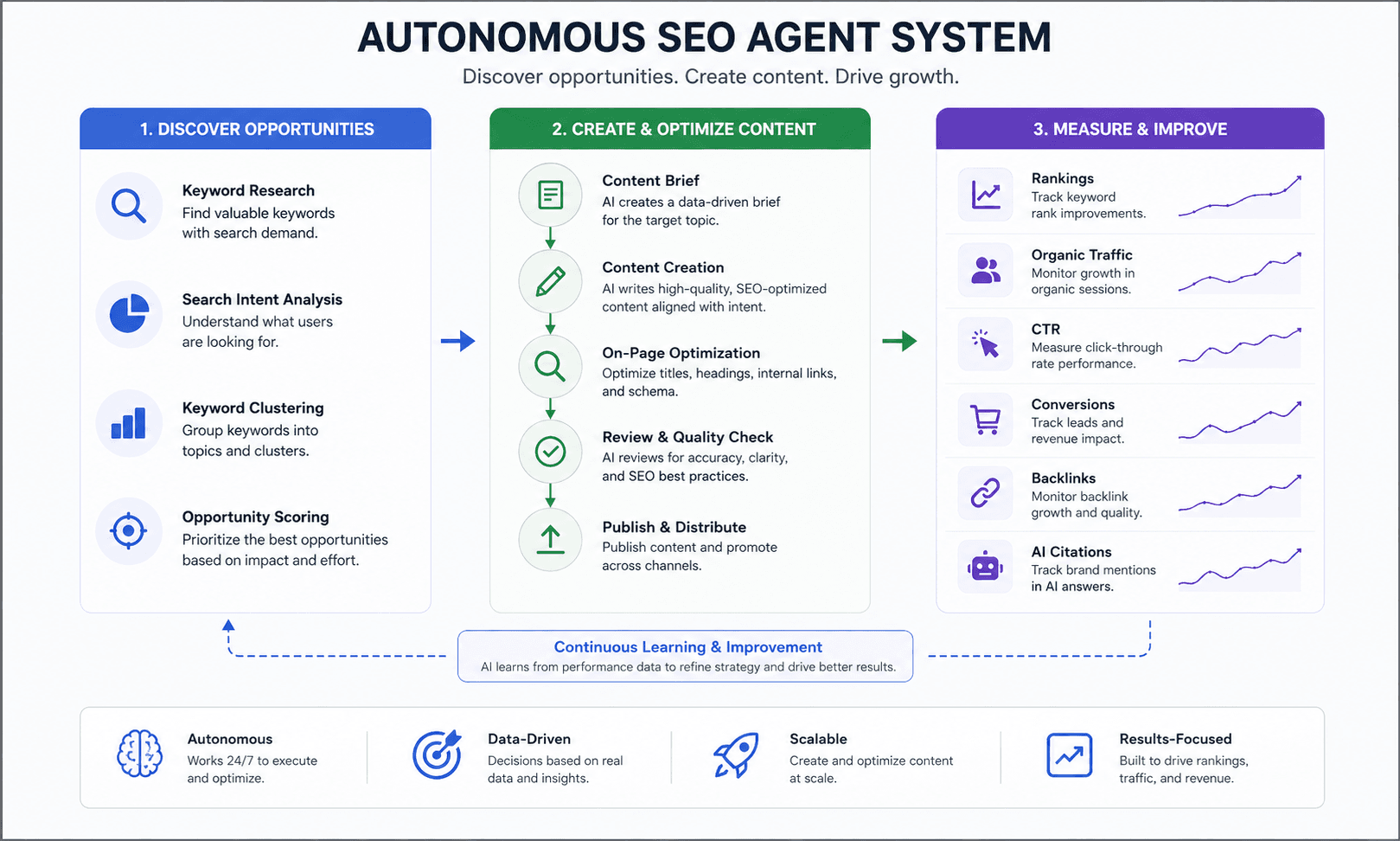
This is what Marketeam.ai means by an integrated marketing environment (IME): one autonomous system with extensive tool use and shared state across the marketing function, rather than a set of dashboards a human stitches together each morning.
The closest analogy is an IDE for marketing — but proactive. An IDE gives a developer everything in one place. An IME does that and then acts: setting sub-goals, sequencing work, executing, observing outcomes, and revising.
Search benefits from this more than any other marketing function, for two reasons. It is the function most dependent on whole-site state — nearly every meaningful SEO decision requires knowing what else exists on the domain. And it has the longest feedback horizon, meaning it needs a system that persists decision context across months rather than sessions.
Search does not operate in isolation
There is a second-order effect worth naming.
An SEO agent working alongside agents handling content, social, analytics, and market intelligence shares signal a standalone system never sees. Which topics are generating engagement elsewhere. What competitive intelligence surfaced this week. Which messaging is converting in paid. Search demand does not originate in search — it originates in the market, and other channels observe the market too.
Marketeam.ai operates a set of specialised AI marketing agents — including dedicated SEO and AEO/GEO functions alongside content, social, campaign, analytics, and market intelligence — sharing one brand context and one KPI framework. The SEO agent is not a product feature sitting beside other product features. It is one specialist in a system where the specialists share what they observe.
The market moment
Through the first half of 2026, a wave of agentic launches from major enterprise platform vendors moved agentic marketing from fringe positioning to default expectation. Every serious platform now claims autonomy in some form.
That is genuine progress, and it changes the evaluation question. It is no longer whether a system claims to be agentic — everything does. The question is whether the architecture underneath was designed for how marketing actually behaves, or whether autonomous language was applied to a workflow still built on linear-task assumptions.
The BCG numbers suggest most organisations have not yet found the difference. Ninety-six percent see transformation coming. Eight percent are running it. That gap does not close with better prompting. The deepest treatment of this argument sits in our analysis of how marketing-specific models are architected differently, and for the full picture of AI agents for marketing beyond search specifically, that broader context is worth the detour. (editor: repoint to the hub guide at publish)
Autonomous SEO in 2026: Where It Genuinely Stands
The question is not whether a system uses AI for SEO. Everything uses AI for SEO. The question is whether it makes decisions or completes tasks.
The honest split, stated once more without softening. Genuine autonomy is available today across query and demand discovery, SERP and competitive monitoring, keyword-gap and cannibalisation analysis, content planning and sequencing, internal-link architecture, technical execution, and continuous performance monitoring. Human ownership remains non-negotiable for strategic positioning, brand risk, claim substantiation, relationship-driven link building, and genuine originality.
Anyone who tells you the first list is shorter is behind. Anyone who tells you the second list is empty is selling.
The AEO dimension changes the urgency rather than the fundamentals. When the default model powering AI Overviews can change globally in a single announcement — as it did on 27 January 2026 — quarterly review cycles are not a cadence, they are a lag. Continuous monitoring has become a structural requirement rather than a refinement.
Four questions are worth taking into any vendor conversation:
Does it set its own sub-goals? Or does it require you to specify every objective in advance?
Does it operate tools without a human selecting each one? Or does a person decide which module to open?
Does it act on feedback that arrives months late? Or does it stop at output and never learn what happened?
Can it see the whole site, or only one workflow stage? Because cannibalisation, link architecture, and sequencing are all invisible from inside a single stage.
Four yeses describe an AI SEO agent. Anything less describes a good product with an ambitious label — which may still be worth buying, but should be bought for what it is.
Which returns us to where this started. Ninety-six percent of CMOs believe AI is transforming their function. Around eight percent have multiple agents operating autonomously in live campaigns. That gap is not a technology problem — the models are good enough and have been for a while.
It is an architecture problem.
See the workflow running on your own site
If the argument here holds for you, the useful next step is watching it operate rather than reading about it. Marketeam.ai’s autonomous SEO and AEO/GEO agents run this workflow end to end — query discovery through planning, publishing, and measurement — inside a single integrated marketing environment, sharing state with the agents handling content, social, campaigns, and analytics.
For the wider context beyond search, the complete 2026 guide to AI agents for marketing covers how the same architectural principles apply across the rest of the function. (editor: repoint to the hub guide at publish)
No transformation narrative required. Just a look at the work.